Cómo 5 Industrias Tradicionales Están Generando Ganancias Silenciosas con IA
Descubre cómo 5 industrias tradicionales —manufactura, agricultura y logística— ya generan retornos reales con IA. Aprende a identificar estas oportunidades antes que el mercado.
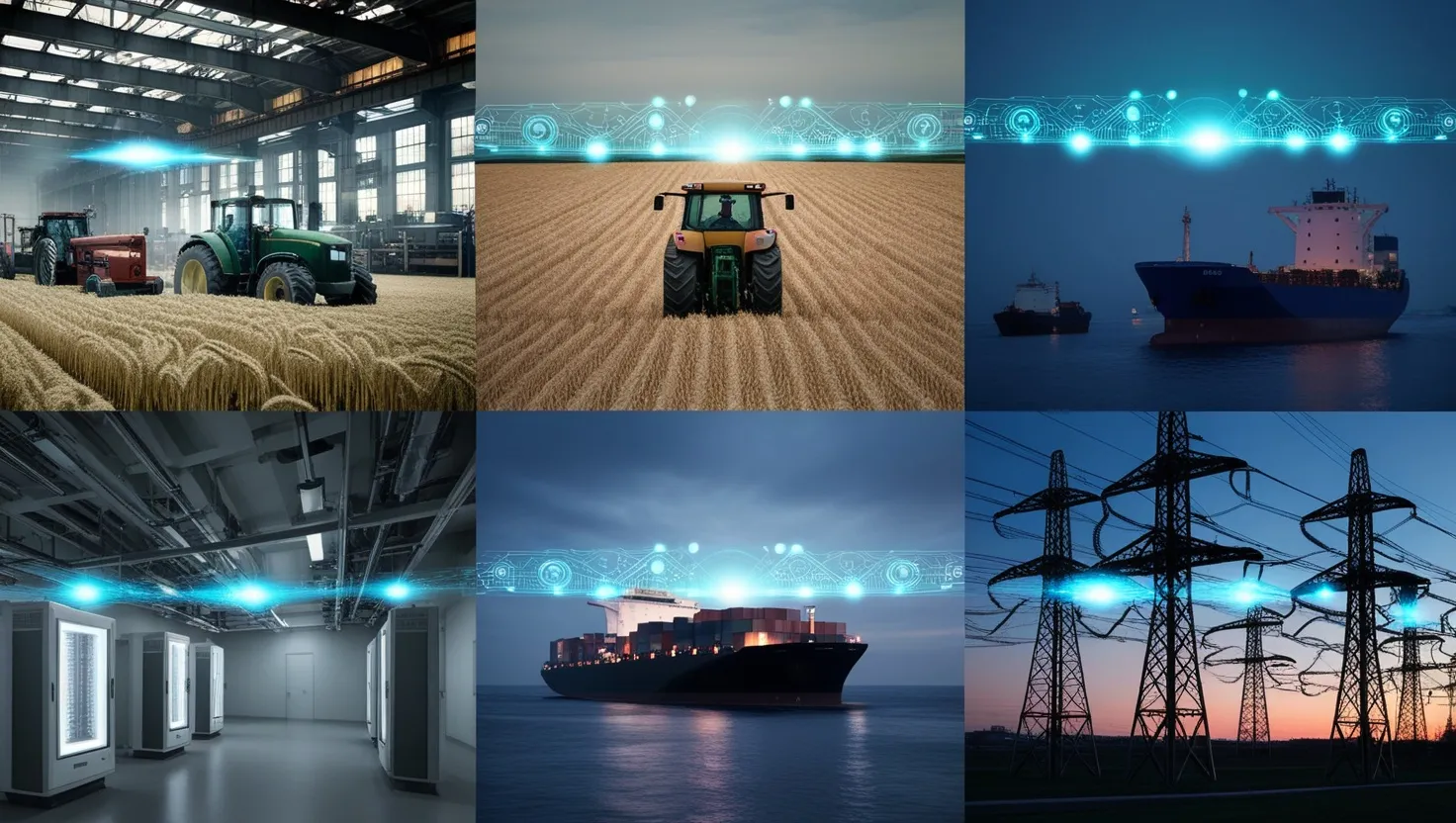
I spent the better part of last year watching the AI boom from a peculiar angle. Everyone around me was chasing Nvidia, Microsoft, and the usual suspects. But the real action, I discovered, was happening in places most investors never glance at. The assembly lines, the wheat fields, the shipping lanes. Quietly, without fanfare, a handful of traditional industries started pulling extraordinary returns from artificial intelligence. And they did it without a single headline about large language models.
Let me walk you through five sectors where the AI boom is already reshaping the bottom line, often in ways that won’t show up in earnings calls for another year or two.
One
A German factory equipment maker caught my attention a few months ago. They produce aging machine tools—lathes, presses, grinders—that many manufacturers still rely on. Instead of scrapping them and buying new smart machines, this company developed a retrofit kit that bolts onto existing equipment. The kit includes a small camera, a few sensors, and a chip running an inference model trained on decades of vibration and temperature data. The AI detects subtle shifts in tool wear and predicts failures three days in advance. The result? A 15% margin boost across their service contracts. Downtime dropped by nearly a third. Their customers paid a premium for a guarantee that a press would run uninterrupted for six months. That’s not a tech story. That’s a machine-shop story.
Industrial automation firms like this one are integrating AI into legacy equipment at a fraction of the cost of replacing entire factories. The secret lies in the retrofit. They aren’t building from scratch. They’re piggybacking on the installed base, which numbers in the millions. Every lathe, every conveyor, every HVAC system becomes a data node. The AI models run on edge devices, sending alerts to maintenance teams before a breakdown happens. The returns compound because the hardware costs are low and the upsell is high. Investors who look for AI adoption signals in industrial R&D spending rather than flashy product launches will spot these opportunities early.
Two
Agriculture surprised me even more. A Midwest farming cooperative I spoke with decided to try computer vision on their sprayer rigs. They attached cheap cameras to the booms and ran an object detection model that distinguishes weeds from crops in real time. The sprayer fires only at the weeds. Pesticide use dropped by 30% in the first season. The cooperative saved nearly $200,000 on chemicals across 5,000 acres. But here’s the angle that rarely gets reported: the AI model was trained on publicly available datasets of crop images, fine-tuned with a few hundred local photos. The total cost to develop and deploy was under $15,000. The cooperative did not hire a data scientist. They used a no-code platform from a startup nobody on Wall Street has heard of.
The broader lesson is that AI in agriculture is not about futuristic robots picking strawberries. It’s about incremental gains on existing equipment. Tractor makers have already embedded GPS and telematics. Adding a camera and a small model turns a dumb machine into a precision instrument. The barrier to entry is absurdly low. Agricultural cooperatives, seed companies, and even irrigation firms are quietly acquiring or building lightweight models that optimize water, fertilizer, and pesticide use. The returns are real, and they are accruing to companies with no “AI” in their name.
Three
Logistics providers have been using optimization algorithms for decades, but the new wave of machine learning is different. A mid-sized shipping firm based in Rotterdam told me their old route planning system was static. It updated every few hours. They replaced it with a reinforcement learning agent that continuously adjusts routes based on real-time fuel prices, weather patterns, port congestion, and driver availability. The fuel cost savings hit 12% in the first quarter. That is not a marginal improvement. It’s a margin-buster in an industry where a 1% fuel saving can swing profitability.
The surprising part is that this firm did not use a massive cloud AI service. They licensed a lightweight model from a niche German logistics software company and ran it on their own servers. The model was trained on their historical shipment data combined with open weather APIs. The entire project took three months. What I find fascinating is how few analysts track these deployments. The adoption signals are not in press releases. They show up in quarterly cost-per-mile metrics. A sharp drop in that number, combined with an increase in on-time delivery rates, usually means an AI has been quietly embedded into operations.
Four
Healthcare diagnostics is the sector everyone talks about, but the angle I find most compelling is not radiology. It’s primary care imaging in low-resource settings. A chain of urgent care clinics in the southeastern US started using an AI algorithm on their existing X‑ray machines. The algorithm spots pneumothorax and fractures faster than a human radiologist. But the real return came from something unexpected: the AI reduced the number of repeat scans. Patients no longer had to come back because a subtle fracture was missed. The clinic chain reported a 20% reduction in unnecessary referrals to specialist imaging centers. That translates directly to lower costs for insurers and higher margins for the clinics.
The less obvious takeaway is that the AI did not replace radiologists. It simply made the existing workflow more efficient. The clinic chain used a pre‑trained model fine‑tuned on their own equipment, which had slightly different resolution and positioning than the original training data. This approach is replicable at scale. Any hospital system with a backlog of imaging studies can customize a model for their specific hardware. The return on investment comes from avoided second visits, reduced litigation risk, and faster throughput. Those metrics rarely appear in AI vendor case studies, but they are the ones that matter for bottom‑line growth in traditional healthcare.
Five
Energy utilities are perhaps the most overlooked beneficiaries of the AI boom. A regional power company in the UK installed vibration sensors and thermal cameras on their grid transformers. The data streamed into a machine learning model that predicted insulation breakdown two weeks before it would have caused a failure. The utility avoided a cascading blackout that would have cost millions in penalties and repairs. But the quieter win came from predictive maintenance scheduling. Instead of sending crews out on fixed intervals, they dispatched them only when the model flagged a high probability of failure. Maintenance costs dropped by 18%.
What I find remarkable is that the model was trained on data the utility already owned—years of repair logs, load patterns, and temperature readings. They did not buy new sensors for the entire grid. They started with a pilot on fifty transformers and expanded once the numbers came back. The framework for evaluating AI adoption in utilities is simple: look for increases in the interval between unplanned outages. When that number rises faster than maintenance spending, AI is likely at work.
Finding the Next Wave
After exploring these five sectors, I developed a simple framework to spot AI adoption before it appears in earnings reports. The first signal is a sudden flattening of cost curves in a traditional business. If a logistics company’s fuel expenses stop rising while volume increases, ask why. The second signal is a change in capital expenditure composition. Companies that shift from buying new equipment to retrofitting old equipment are usually embedding AI. The third signal is an uptick in data hiring, but not necessarily data scientists. Look for data engineers and data architects in industries that never had them before. The fourth signal is a quiet acquisition of a small AI startup that has no product, only a trained model. That acquisition will be classified as “technology” and buried in the footnotes.
The last signal is the hardest to quantify but the most telling. Talk to frontline workers. The technician who used to replace filters every month and now replaces them only when the dashboard says so. The farmer who used to spray the whole field and now sprays only the weed patches. When the frontline stops doing their old job and starts monitoring an AI’s recommendations, the adoption is real.
The AI boom is not confined to Silicon Valley. It is running on a lathe in Stuttgart, on a sprayer in Iowa, on a container ship leaving Rotterdam, on an X‑ray machine in a strip mall clinic, and on a transformer in the English countryside. The returns are already visible to anyone who looks beyond the stock tickers. The next wave of growth will not announce itself. It will simply show up in the margins.